Secret Bologna: 9 Hidden Spots Most Tourists Miss

Most visitors see Bologna in a hurry. They take a photo of the Two Towers, eat a plate of tagliatelle, walk through Piazza Maggiore and move on. But the real magic of Bologna is in the details most people walk straight past: arrows stuck in a wooden ceiling, a stone archway that carries a whisper, a Roman street hidden under a library floor.
Our guides show these secrets on almost every tour, and they are always the moments people remember most. The best part is that you don’t need tickets, a car or a full day to find them. Almost all the hidden spots in this guide are within a 15-minute walk of Piazza Maggiore.
In this guide, you will discover nine secret spots in Bologna, the stories and legends behind them, how to find each one, and a simple walking route that links them all together. If you love hidden gems in Bologna, keep reading.
Discover with us
1. The Whispering Gallery under the Voltone del Podestà
Right next to Piazza Maggiore, under the Palazzo del Podestà, there is a large vaulted crossing called the Voltone. It looks like an ordinary passage, but it hides one of Bologna’s favourite tricks.
Stand in one corner of the vault, facing the wall, and ask a friend to stand in the opposite corner. Now whisper. Your friend will hear every word clearly, even with people walking between you. The sound travels along the curved ceiling from one corner to the other.
Locals call it the “telefono senza fili”, the wireless telephone. Legend says it was used to let lepers confess to priests without coming close, or to let lovers share secrets in public. Nobody knows which story is true, but everyone who tries it laughs in surprise.
Local tip: try it early in the morning or late in the evening, when the square is quieter. Kids love it, and so do adults.
2. The Three Arrows of Strada Maggiore
Walk along Strada Maggiore toward the Basilica of Santa Maria dei Servi and stop under the portico of Casa Isolani, one of the oldest wooden porticoes in the city. Now look up. Stuck in the wooden beams of the ceiling are three old arrows.
The most famous legend tells of three archers hired to kill a nobleman who lived in the house. At the exact moment they were about to shoot, a beautiful woman appeared at the window, and in some versions of the story she wasn’t wearing very much. Distracted, the archers missed their target, and the arrows ended up in the ceiling, where they have stayed for centuries.
Local tip: the arrows are small and high up, so they are easy to miss. Look for them at number 19, and challenge your travel partner to spot them first.
3. The Cheeky Secret of the Neptune Statue
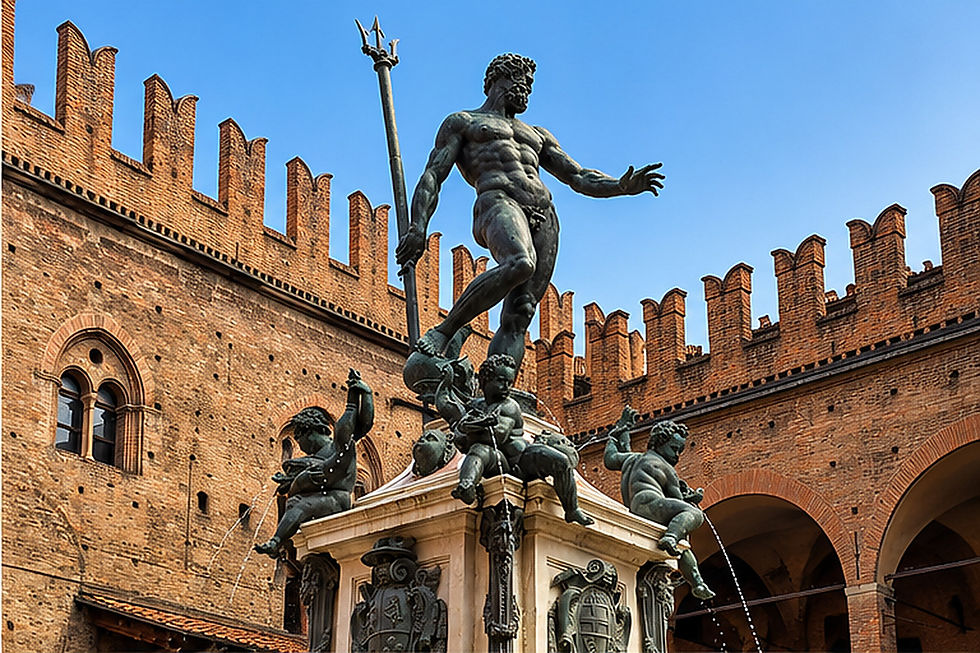
The Fountain of Neptune is one of Bologna’s symbols, and almost every visitor takes a photo of it. Very few know about its hidden joke.
When the sculptor Giambologna created the statue in the 1500s, the Church asked him to keep Neptune modest. According to local legend, he found a clever way to have the last laugh. If you stand on a particular dark stone in the pavement behind the statue and look at Neptune’s outstretched left hand, his thumb seems to change into something much more anatomical.
Our guides always save this one for the end of the stop, and it never fails to make a group laugh.
Local tip: the stone sits on the side facing Salaborsa. Ask a local, or join a tour, and someone will happily show you where to stand.
4. The Roman Ruins under Salaborsa
Right next to the Fountain of Neptune is Salaborsa, Bologna’s main public library, inside Palazzo d’Accursio. It is a beautiful building with an iron and glass roof, but the real surprise is under your feet.
The central hall has a glass floor, and through it you can see the remains of ancient Bologna: Roman foundations, old walls and traces of the city’s long history, layered one on top of the other. It is one of the easiest ways to see how deep Bologna’s past really goes.
Entry to the library is free, and it is a great place to warm up on a cold day or cool down in summer.
Local tip: guided visits to the excavations below are sometimes available. Ask at the library entrance if you want to go down for a closer look.
5. The Giant Sun Line in San Petronio

Inside the huge Basilica of San Petronio, look down at the floor along the left side of the church. You will see a long brass line running across the marble.
It was designed in 1655 by the astronomer Gian Domenico Cassini. A small hole in the roof lets in a ray of sunlight, and at solar noon that spot of light falls on the line, marking the day of the year. For centuries it was used to measure time, check the calendar and study the movement of the Earth.
It is a fascinating mix of science and faith, hidden in plain sight in Bologna’s most famous church.
Local tip: if you visit close to midday, wait for a few minutes and watch the patch of sunlight move along the line.
6. The Crying Statues of Santa Maria della Vita
A few steps from Piazza Maggiore, on Via Clavature, there is a small church that many visitors walk straight past. Step inside Santa Maria della Vita and turn into the side chapel, and you will find one of the most powerful sculptures in Italy.
The Compianto sul Cristo morto (the Lamentation over the Dead Christ) is a group of life-size terracotta figures made by Niccolò dell’Arca in the 15th century. They gather around the body of Christ, crying and screaming with grief. Their faces and clothes feel so real that the scene almost seems to move.
There are no crowds and no queues. It is just a quiet room and a work of art that stays with you for a long time.
Local tip: take a few minutes in silence before taking photos. The emotion of the faces is the reason to come.
7. The Old Jewish Ghetto
Just behind the Two Towers is a quiet maze of narrow medieval streets: Via de’ Giudei, Via dell’Inferno and Vicolo San Giobbe. This was Bologna’s Jewish Ghetto, created in 1556, when the city’s Jewish community was forced to live inside this small area, with gates that were closed at night.
Today it is one of the most peaceful corners of the old town. Look up and you will see small covered bridges connecting houses across the streets, tiny windows and old doors. The Jewish Museum of Bologna nearby tells the full story of the community.
Local tip: visit in the late afternoon, when the light turns golden on the brick walls. It is also one of the best areas for quiet photos without crowds.
8. The View from the Clock Tower

The Asinelli Tower is Bologna’s most famous viewpoint, but in 2026 it has been closed for maintenance. Luckily, there is a great alternative that many visitors don’t know about: the Clock Tower of Palazzo d’Accursio, right on Piazza Maggiore.
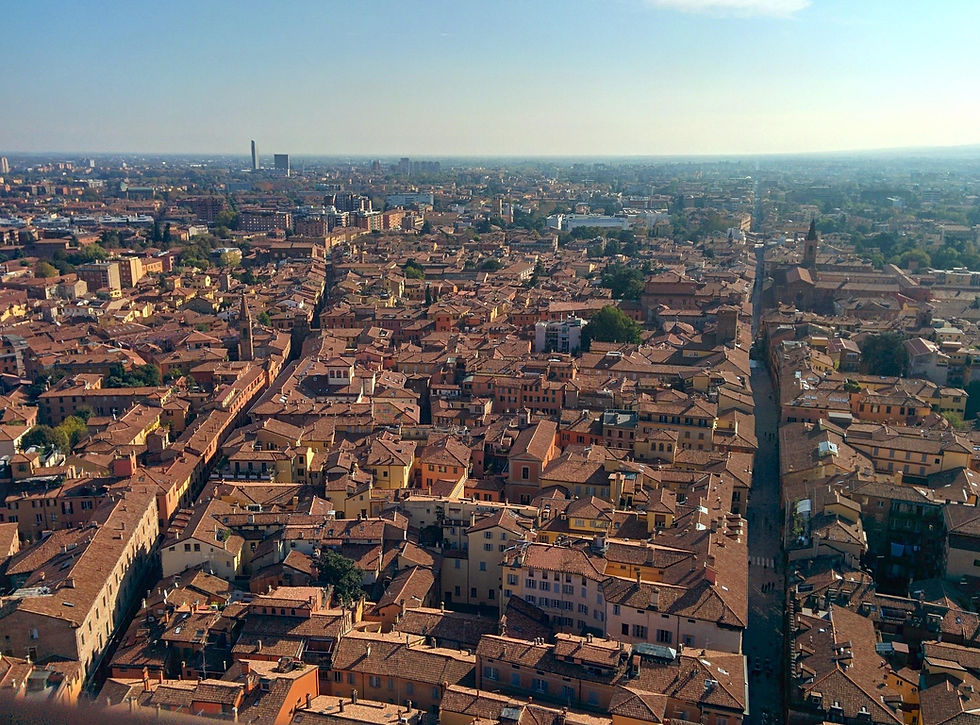
The visit takes you through the courtyards and grand staircases of the palace, past the clock’s old mechanism, and up to two panoramic terraces with a beautiful view over the square, San Petronio and the red rooftops of the city. A full ticket costs €10 and includes an audio guide on your smartphone, plus entry to the Municipal Art Collections.
Local tip: book a time slot in advance through Bologna Welcome, especially at weekends. Bring headphones for the audio guide.
9. Osteria del Sole, the Bar Where You Bring Your Own Food
Hidden down a tiny alley in the Quadrilatero, Osteria del Sole has been open since 1465, making it one of the oldest osterias in Italy. It has a simple rule: it serves only wine and beer, no food. So you bring your own.
Locals buy mortadella, cheese and fresh bread in the market shops nearby, then sit at the long wooden tables with a glass of wine. Students, workers and old regulars share the space. It feels like stepping into a different century.
Local tip: the osteria is closed on Sundays. Shop for your picnic in the Quadrilatero first, and remember that you can’t bring your own drinks.
10. A walking route to see them all
All nine spots are close together, so you can see them in a relaxed two- to three-hour walk:
Start at the Fountain of Neptune and find the stone of the cheeky illusion.
Step into Salaborsa to see the Roman ruins under the glass floor.
Cross to the Voltone del Podestà and try the whispering gallery.
Climb the Clock Tower for the view over Piazza Maggiore (book ahead).
Visit San Petronio and its meridian line, ideally around midday.
Walk to Santa Maria della Vita for the Compianto.
Have a drink and a picnic at Osteria del Sole in the Quadrilatero.
Wander through the Jewish Ghetto behind the Two Towers.
Finish on Strada Maggiore and look for the three arrows.
Want someone to show you the way and tell you the stories as you go? Several of these secrets, including the whispering gallery and the Neptune legend, are part of our Bologna Walking Tour, where a local guide takes you through the old town and its hidden corners. In the evening, our Bologna Pubcrawl is a fun way to discover the city’s nightlife with a local crew.
Looking for more hidden places? Read our guide to 5 Unexpected Things to Do in Bologna with the hidden canal window, the Portico of San Luca and the underground tours.
11. FAQ
What are the best hidden gems in Bologna?
Some of the best are the whispering gallery under the Voltone del Podestà, the three arrows on Strada Maggiore, the Roman ruins under Salaborsa, the meridian line in San Petronio and the Compianto in Santa Maria della Vita.
Where is the whispering gallery in Bologna?
It is under the Voltone del Podestà, the vaulted passage beneath the Palazzo del Podestà, next to Piazza Maggiore. Stand in opposite corners and whisper toward the wall.
What is the legend of the three arrows in Bologna?
Legend says three archers tried to kill a nobleman in Casa Isolani on Strada Maggiore, but were distracted by a woman at the window. They missed, and the arrows stayed in the portico ceiling.
Is Salaborsa free to visit?
Yes. Salaborsa is a public library, and entry is free. You can see the Roman ruins through the glass floor of the main hall.
Can you see Bologna’s secrets on a walking tour?
Yes. Our Bologna Walking Tour includes several of the city’s hidden stories, and a local guide can show you exactly where to look.
12. Conclusion
Bologna rewards travellers who slow down. The famous towers and squares are worth seeing, but the moments people remember are smaller: whispering across an archway, finding arrows in a ceiling, or watching a spot of sunlight move across a church floor. These secrets are free, close together and full of stories, so add a few to your next walk through the city.
If you want to discover them with a local, join one of our Bologna tours. Follow us on Instagram @thewalkingparrot for more hidden gems, and stay tuned for our next guide.


Comments