Best Things to Do in Lodz: The Ultimate Local Travel Guide

Lodz is often overlooked by travelers flocking to Warsaw or Krakow, but it is undoubtedly one of the most fascinating cities in Europe. Once the booming center of Europe's textile industry in the 19th and early 20th centuries, the city earned the nickname "the Polish Manchester." However, when the massive factories eventually closed, they left behind enormous red-brick complexes that have recently undergone spectacular urban revivals. Today, Lodz is a thriving hub of modern art, incredible gastronomy, and cutting-edge design, seamlessly blending its industrial past with a highly creative future.
If you are planning a trip to Poland and want to step off the heavily beaten tourist path, Lodz offers an authentic and unforgettable experience. From walking down one of the longest commercial streets in Europe to exploring world-class museums housed inside former cotton mills, there is no shortage of unique attractions. In this comprehensive guide, you will discover the absolute best things to do in Lodz, where to find the most impressive street art, the top places to enjoy traditional Polish cuisine, and why this industrial city should be at the top of your travel itinerary.
Table of Contents

What is Lodz Famous For?
Walking Down Piotrkowska Street
Exploring the Manufaktura Complex
Discovering Lodz Street Art and Murals
Stepping Back in Time at Księży Młyn
The History of Polish Cinema: HollyLodz
Off Piotrkowska: The Hipster Heart of the City
Traditional Polish Food: What to Eat in Lodz
Frequently Asked Questions (FAQ)
What is Lodz Famous For?
Before diving into specific attractions, it is incredibly helpful to understand what makes Lodz so unique. Unlike older Polish cities that are centered around medieval market squares and cobblestone alleys, Lodz was built rapidly during the Industrial Revolution. It is famous for three main pillars: textiles, cinema, and street art. In the 19th century, powerful textile magnates built massive red-brick factories and lavish, highly decorated palaces right next to each other. When the industry collapsed in the 1990s, the city was left with enormous abandoned spaces.
Instead of tearing them down, the city repurposed them. This massive architectural transformation is what Lodz is most famous for today. Furthermore, the city is the heart of the Polish film industry, boasting a world-renowned film school that produced legends like Roman Polanski. More recently, Lodz has gained massive international recognition for its towering murals, transforming the city into a giant open-air art gallery. Understanding this rich background will make your visit much more meaningful as you explore the streets and notice the stark contrast between ornate palaces and raw industrial architecture. You can learn more about this rich history on our Lodz Walking Tour.
Walking Down Piotrkowska Street
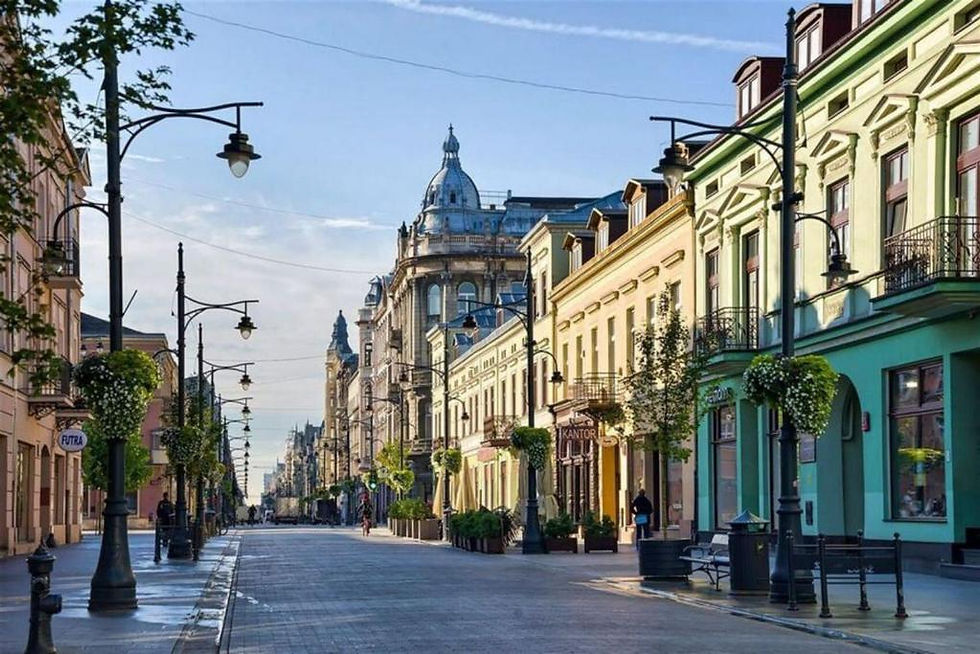
At the very heart of the city lies Piotrkowska Street, stretching for over four kilometers. It is one of the longest commercial thoroughfares in Europe and serves as the central spine of Lodz. Unlike other cities where life revolves around a central square, in Lodz, everything happens along Piotrkowska. The street is lined with stunning 19th-century tenement houses, neo-renaissance palaces, and eclectic villas built by the wealthy factory owners of the past.
As you walk, you will notice bronze statues of famous locals, including the iconic monument of Arthur Rubinstein playing a grand piano. You can even sit next to him for a memorable photograph. But the true magic of Piotrkowska Street lies hidden behind the main facades. If you duck into the numerous courtyards known locally as "podwórka" you will discover a completely different world. These courtyards are filled with hidden gardens, independent art galleries, cozy pubs, and spectacular light installations like the famous Rose Passage (Pasaż Róży), where an entire courtyard is covered in millions of broken mirror pieces. Our guides often recommend taking your time to explore these off-the-beaten-path courtyards, as they offer the most authentic local experience away from the main crowds.
Exploring the Manufaktura Complex
No trip to Lodz is complete without spending a few hours at Manufaktura. This is not just a shopping mall; it is one of the largest and most successful revitalization projects in Central Europe. Originally the textile empire of Izrael Poznański, one of the wealthiest industrialists in Lodz, the massive red-brick complex spans 27 hectares. After falling into ruin, it was meticulously restored and reopened in 2006 as a vibrant cultural, entertainment, and commercial hub.
Today, Manufaktura houses over 300 stores, dozens of restaurants, a modern cinema, a climbing wall, and even a zipline. However, the cultural offerings are what truly make it special. Inside the complex, you will find the MS2 Museum of Art, which hosts an impressive collection of avant-garde and contemporary art. You can also visit the Factory Museum to learn about the harsh working conditions of the 19th-century textile workers and see original weaving machines in action. The central square of Manufaktura is a gathering place for locals, hosting outdoor concerts, a man-made beach in the summer, and an ice-skating rink during the winter months.
Discovering Lodz Street Art and Murals

If you are an art enthusiast, Lodz is a paradise. The city is globally recognized for its monumental street art, which covers the blank sides of old tenement buildings across the city center. This initiative started as a way to breathe new life into neglected neighborhoods and has rapidly evolved into an open-air gallery featuring works by world-renowned artists such as Os Gemeos, Eduardo Kobra, ROA, and Aryz.
There are over 150 large-scale murals scattered throughout Lodz. They vary heavily in style from hyper-realistic portraits to abstract geometric designs and surreal landscapes. One of the most famous pieces is the giant mural of Arthur Rubinstein, which adds a massive splash of vibrant color to the cityscape. Taking a self-guided walking tour to hunt down these murals is an excellent way to see different local neighborhoods and understand the city's modern identity. We cover several of these iconic artworks in our comprehensive Poland Street Art Guide, which details the stories and artists behind the paint. Many of these massive artworks are included in our Lodz Walking Tour, where we visit both the famous centerpieces and the hidden murals.
Stepping Back in Time at Księży Młyn
For a deep dive into the city's industrial heritage, you must visit Księży Młyn (Priest's Mill). This area is a brilliantly preserved 19th-century industrial settlement built by Karol Scheibler, another of Lodz's great textile barons. Scheibler envisioned a "city within a city," and he succeeded in creating a massive, self-sustaining complex that operated completely independently.
Księży Młyn consists of immense spinning mills, row houses for the factory workers, a hospital, a school, a fire station, and the owner's lavish palace. Walking through the neat, repetitive rows of red-brick workers' houses feels exactly like stepping onto a period film set. Today, the area is undergoing a gradual, careful revitalization. While some buildings still function as everyday residential apartments, others have been converted into trendy loft spaces, design studios, and chic cafes. The atmosphere here is noticeably quieter and more reflective than the bustling Piotrkowska Street, offering a fascinating glimpse into the daily lives of the thousands of workers who once fueled the city's booming economy.
The History of Polish Cinema: HollyLodz
Lodz and cinema are deeply intertwined, earning the city the affectionate nickname "HollyLodz" (pronounced Holly-Woodge). After World War II, when Warsaw was largely destroyed, the Polish film industry relocated to Lodz, establishing the legendary National Film School. This institution trained some of the greatest minds in global cinema history, including Andrzej Wajda, Krzysztof Kieślowski, and Roman Polanski.
To explore this cinematic heritage, a visit to the Cinematography Museum is highly recommended. Located inside the opulent 19th-century palace of Karol Scheibler, the museum perfectly contrasts its lavish, wood-paneled interiors with fascinating exhibitions of vintage cameras, original film posters, and authentic set props. You can even see the original stereoscopic Kaiser-Panorama from the late 19th century. Walking through the city, you will likely spot stars embedded in the pavement along Piotrkowska Street Lodz's very own Walk of Fame honoring the directors, actors, and cinematographers who shaped Polish and international cinema.
Off Piotrkowska: The Hipster Heart of the City
When the sun goes down, or when you simply need a break with an exceptional cup of coffee, head to Off Piotrkowska. Located at Piotrkowska 138/140, this space is another fantastic example of urban regeneration. Housed in the former Ramisch cotton mill, this raw complex has been transformed into the undisputed center of Lodz's alternative and youth culture.
The rugged, unplastered brick walls and post-industrial aesthetic provide the perfect backdrop for independent fashion boutiques, concept stores, and vinyl record shops. However, the main draw here is the culinary and nightlife scene. You will find artisanal bakeries, specialty coffee roasters, craft beer pubs, and food trucks serving everything from gourmet burgers to vegan ramen. It is the perfect place to mingle with the city's youth, listen to live independent music, and soak up the creative energy that defines modern Lodz. Our local guides always point visitors here for the best evening atmosphere.
Traditional Polish Food: What to Eat in Lodz

Exploring a city's history makes you hungry, and traditional Polish food is hearty, comforting, and packed with flavor. While you can find standard Polish classics like Pierogi (dumplings) and Kotlet Schabowy (breaded pork cutlet) everywhere in the country, Lodz has a few regional specialties tied directly to its working-class roots.
The most famous local dish is Zalewajka. This is a rustic, sour rye soup similar to the national dish Żurek, but specifically adapted by the factory workers of Lodz. It is traditionally made with diced potatoes, onions, garlic, and locally smoked sausege, poured over with a fermented rye flour starter. It is incredibly warming and savory. Another popular local dish is Knedle ze śliwkami (plum dumplings). These are potato dough balls stuffed with whole plums, typically served with a dollop of sweet cream and a sprinkle of sugar a perfect balance of sweet and tart. To find the best traditional restaurants and local taverns, check out our Polish Food Guide, or join our Lodz Food Tour to taste these authentic flavors directly.
Frequently Asked Questions (FAQ)
What is the best time of year to visit Lodz?
The best time to visit Lodz is during the spring (May to June) and early autumn (September to October). The weather is pleasant for walking, and the city hosts numerous cultural events and light festivals without the heavy crowds of mid-summer.
How do I get from Warsaw to Lodz?
Lodz is extremely accessible from Warsaw. The most convenient way is by train. Direct trains leave frequently from Warsaw Central Station (Warszawa Centralna) and arrive at Lodz Fabryczna (the stunning modern main station in Lodz) in about 90 minutes.
Is Lodz a walkable city?
Yes, the city center is highly walkable, especially along the pedestrian-friendly Piotrkowska Street. However, because some attractions like Księży Młyn and Manufaktura are spread out, utilizing the city's extensive and affordable tram network can save you a lot of time and energy.
Are there good vegetarian options in Lodz?
Absolutely. Despite traditional Polish cuisine being quite meat-heavy, Lodz has a thriving vegan and vegetarian scene, particularly around the Off Piotrkowska area, where you can find excellent plant-based restaurants and cafes.
Conclusion
Lodz is a city that heavily rewards curious travelers. It lacks the medieval castles of other Polish destinations, but it makes up for it with breathtaking industrial architecture, an incredibly vibrant art scene, and a tangible sense of transformation. From the bustling energy of Piotrkowska Street to the historical depths of the Manufaktura complex and the cinematic legacy of its film school, exploring Lodz offers a deeply enriching cultural experience.
Taking the time to discover the hidden courtyards, taste the local Zalewajka, and hunt for world-class street art is one of the best ways to understand the city's unique charm. "Exploring Lodz's food and art scene is one of the best ways to understand the city's culture." We highly recommend booking our Lodz Walking Tour to ensure you don't miss any of the fascinating stories and hidden gems this incredible city has to offer. Pack your bags and get ready to experience the creative heartbeat of Poland!


Comments